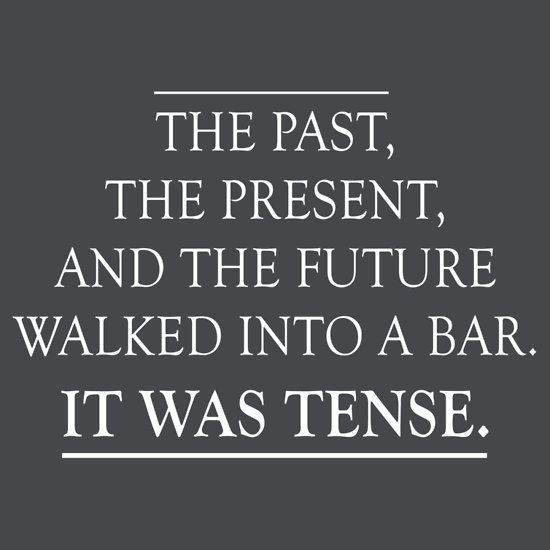
One way to prevent avoidable errors is to monitor your writing tense. Always be aware of whether you’re writing in the present tense (I am writing these words), the past tense (I wrote those words), or the future tense (I’m going to write the words).
Be conscious of your presentation and how it reads. If you switch tenses throughout a piece of content, it can be difficult to follow and your overall point can be lost or muddled. Readers shouldn’t have to keep track of when they’re supposed to implement a piece of information.
For example:
Support the barbell across your traps and rear delts. When you’ve unracked the bar, settle into a comfortable stance. After you’ve descended into a squat, pause briefly when your thighs are parallel to the ground. Stand up to lockout before racking the bar.
That’s all over the place and not as clear as possible. It’s a mish-mash of present, past, and future throughout the paragraph. Instead, be consistent to have the information flow more naturally.
Here’s a better way:
Support the barbell across your traps and rear delts. Unrack the bar and settle into a comfortable stance. Descend into a squat and pause briefly with your thighs parallel to the ground. Stand up to lockout and rack the bar.
The changes can be subtle, but the instructions are more streamlined and easier to follow, so the clarity is improved. (It’s tough to explain how to squat in just four sentences, but focus on the general idea and the differences between each sample.)
Sometimes it can be tricky to determine, but always double-check your tenses. Train yourself to watch for words ending in -ed or -ing and decide if you’re being consistent throughout the entire piece of writing or if you’re bouncing between them from sentence to sentence.
Is your advice coming from right now, in the present? Are you speaking in anticipation of an upcoming event? Or are you looking back as if it already occurred?
Email us now to take a free skills assessment and learn
how to hit new PRs in your writing.
 The Write Spotters
Leave a comment